
Both affiliate marketing and influencer marketing promise fruitful results for brands, but which one will you go with?
The popularity of affiliate marketing is growing as it focuses on performance, numbers, and analytics. In contrast, influencer marketing works around communities, people’s emotional attachment, storytelling, content, etc.
Both affiliate marketing and influencer marketing are today’s top bets for brands. In fact, affiliate marketing’s value is expected to hit $31.7 billion by 2031, whereas influencer marketing is already worth $24 billion in 2026.
However, when the numbers might look attractive, you, as a brand, must know the differences between these two tools and their underlying potential to thrive in today’s market.
So, let’s jump right into the topic.

How Affiliate Marketing Works
When you let an affiliate platform or an individual affiliate promote your product or service, agreeing to pay commissions for successful sales or leads, it’s affiliate marketing.
There’s a reason why the term affiliate marketing is coined with performance-based marketing. It’s because of its result-only commission system.
It means you only pay the affiliate when they bring in solid leads or successful sales.
Affiliate Functions:
- A brand sets up an affiliate program.
- The brand reaches out to affiliates, or affiliates join the program.
- The affiliates promote the brand through unique tracking links or promo codes.
- Interested visitors click those links and, if agreed, make purchases.
- The sales are tracked and confirmed while the affiliates get paid.
Why does it work:
- Sales are trackable. No guesswork.
- You can increase sales by adding more affiliates.
- No blind expense. You only pay for successful sales or lead conversions.
- It works for a range of business types: from e-commerce to SaaS.
How Influencer Marketing Works
Influencer marketing is about building trust and visibility through people with a loyal following or fanbase. It focuses more on content relevance than on driving sales only.
Since influencers are socially active on platforms like Facebook, Instagram, YouTube, X, etc., promoting your brand through them is highly likely to hit the goal.
Moreover, influencers create content around a topic that connects with people on social media as well as in real life.
Influencer campaigns:
- A brand approaches an influencer directly or through an agency.
- A brand offers them compensation or value in exchange for their promotion.
- The influencer agrees to promote your brand by creating content.
- The content engages their fanbase, the fanbase clicks the trackable link, and they may purchase it.
Why does it work:
Influencers92% consumers trust influencer content over traditional ads.- The content created by the influencers is often reusable.
- It creates recurring and referral sales due to the large, loyal follower base.
Why Brands Need to Compare Affiliate Marketing Vs. Influencer Marketing
Both affiliate marketing and influencer marketing come with distinct goals, approaches, and results. Hence, investing in any of it without understanding your business goal can lead to a waste of time and resources.
That’s why you must learn to compare one with the other.
1. Understanding the Goals:
Affiliate Marketing—
- Its goal is to drive performance: sales, leads, conversions
- It focuses on driving ROI and growth
- It can be a gateway to long-term affiliate relationships via affiliate websites and affiliate networks
- It’s ideal for brands seeking to improve revenue efficiency
Influencer Marketing—
- It’s aimed at brand awareness, exposure, and credibility
- It aims to change attitudes and behaviour
- It uses the influencer’s authority to sway consumers indirectly
- It’s most effective for brand awareness, storytelling, and discovery
2. The Required Tools or Resources
Affiliate Marketing—
- Affiliate software programs or affiliate networks (tracking and partner management)
- Custom links, cookies, coupon codes
- Affiliate dashboards for reporting
- Affiliate recruitment (bloggers, vloggers, affiliate sites)
- Affiliate commissions structure and payment system
Influencer Marketing—
- Influencer discovery tools or agencies
- Social media platforms (Instagram, TikTok, YouTube)
- Campaign briefs and guidelines
- Insight into reach, engagement, and impressions
- Agreements, negotiations, and the content approval process
3. Investment Prospect
Affiliate Marketing—
- Low risk (pay-per-performance)
- Only pay if a result is achieved
- Budget scales with results
- Reduced financial risk, better ROI predictability
- Especially recommended for cost-sensitive and budget-conscious brands
Influencer Marketing—
- Initial investment (fixed fees, gifting, retainer fees)
- Fees based on content creation and exposure
- ROI can be varied based on engagement and conversions
- Greater risk with poorly performing campaigns
- Good for brands looking for brand building
4. Planning & Execution
Affiliate Marketing—
- Involves initial planning (program set-up, commission structure, tracking)
- Continual affiliate recruitment and management
- Ongoing tracking and optimisation
- Affiliate-generated content, such as blogs, videos, and affiliate sites
- Emphasis on long-term, sustainable growth
Influencer Marketing—
- Campaign planning (time, content type, deliverables)
- Influencer target based on topic, audience, and engagement rate
- Creative direction and content collaboration
- Short-term planning with campaign cycles
- Emphasis on captivating storytelling and engagement
Key Differences Between Affiliate Marketing and Influencer Marketing
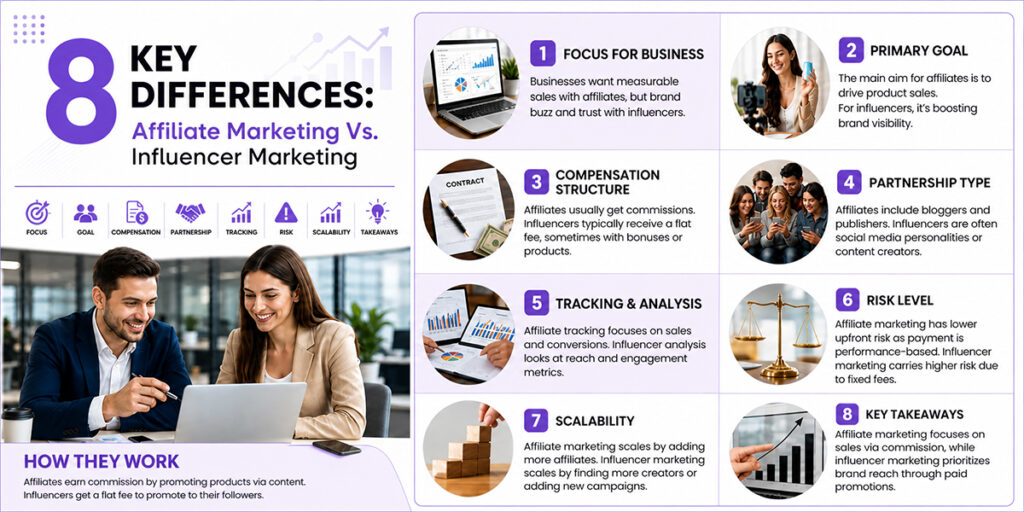
Whether you’re a brand looking to increase sales of your product or service, or aiming at establish your brand value within your target audience, it’s essential to know the difference between affiliate marketing and influencer marketing.
In this section, we’re going to highlight the core differences between these two types of marketing:
| Criteria | Affiliate Marketing | Influencer Marketing |
| How it works | Affiliates earn commission while promoting products or services through creating content. | Influencers promote products or services to their loyal follower base in exchange for a flat fee. |
| Focal Point | Businesses aim for measurable, performance-based metrics: sales, clicks, leads, etc. | Businesses want to create a buzz about their brands, leading to community engagement and gaining trust through influencers’ content. |
| Goal | The goal is to maximize sales of the products or services. | The goal is to increase brand visibility among the target audience. |
| Compensation Structure | Mostly, the affiliates are paid through a commission-based structure. For instance: per-sale-commission, per-lead-commission, per-subscription-commission, etc. | Typically, the influencer gets a flat fee in exchange for promoting a brand to their audience. Some may only agree to receive product-based or performance-based incentives. |
| Partnership Type | Typically, affiliates, content marketers, bloggers, or publishers collaborate with brands. | Usually, influencers on social media platforms, YouTube, blog sites, or from other media channels come to an agreement with the brands. |
| Tracking & Analysis | The individual affiliates or affiliate platforms use robust analytics tools for real-time tracking and performance analysis, such as Scaleo, Brandwatch, Referral Factory, and more. | Although they seem to be vanity metrics, such as Reach, Impressions, Engagement, etc., they’re useful in evaluating brand visibility, community engagement, etc.—always help with refining the campaigns, target audience, and promotional offers. |
| Risk Level | It comes with lower upfront risk since brands only pay the affiliates for successful purchases or lead conversions. | A little higher risk is associated with this since influencers typically are paid fixed fees, gifts, and long-term retainers. |
| Scalability | Affiliate marketing can be scaled up by adding more affiliates within the particular network. | Influencer marketing is scaled up by adding more content creators or new campaigns. |
Pros and Cons of Affiliate Marketing
Learn the advantages and downsides of affiliate marketing:
Pros:
- You only pay for the results; a completely performance based marketing method.
- Low risk in upfront payment
- Easily trackable ROI
- Guides in long-term growth
- Performance is scalable by expanding affiliate networks
Cons:
- Requires an appropriate tracking setup
- Takes time to get the initial traction
- The performance depends on the affiliate quality
Pros and Cons of Influencer Marketing
Influencer marketing comes with its own bright sides and downsides:
Pros:
- Builds a long-term audience trust
- Establishes brand awareness
- Increases brand visibility
- Perfect for product launches
Cons:
- Flat, one-time fees often prove to be high upfront risk
- Sales aren’t guaranteed
- Hard to measure ROI
A Fictional Case Scenario
(Illustrating What Real-Life Affiliate and Influencer Marketing May Look Like)
Brand: Threadora
Product: Clothing
Case Scenario: A clothing brand launches a new summer collection using two strategies: affiliate marketing and influence marketing.
Threadora initiated an influencer marketing campaign where it collaborated with fashion content creators. The content creators posted outfit reels and styling videos on their Facebook, Instagram, and YouTube channels.
Within a few days, the reels and videos started gaining attention and engagement. It created the buzz the brand wanted. However, the sales didn’t come easily. There were trust issues and a lack of interest on the audience’s side. Besides, poor content quality was another factor that failed to promote the brand properly.
Overall performance:
- Investment: $20,000 (4 influencers)
- Campaign Duration: 21 days
- Reach: 6,20,000+ views
- Engagement: 50,000+ likes, 3,890 comments
- Conversions: ~230 sales Vs. target 1,000 sales
- ROI: Moderate (mostly, awareness-driven)
- Analytics Key Indicators: Impressions, engagement rate, audience insights
Results below expectations with influencer marketing in terms of sales, Threadora opted for affiliate marketing. They gained attention, but needed to shake the numbers. Hence, they joined with a reliable affiliate platform named GrowthLynk.
The platform initiated the project within its affiliate network. The affiliates started promoting Threadora’s stylish clothes through promo codes and tracking links. It took about a week to gain traction, but sales started happening in twos and threes from then onward. Each successful purchase through those links and codes earned them commissions. Thus, even through a slow start, sales started increasing, delivering measurable and clear results.
Overall performance:
- Investment: $8,000 (setup + commissions)
- Campaign Duration: 60 days
- Traffic: 35,000 targeted clicks
- Conversions: 670 confirmed sales Vs. 800 target sales
- Revenue Generated: $38,000
- ROI: High, performance-driven
- Analytics Key Indicators: Clicks, conversions, revenue, partner performance
Key Takeaways:
- Influencer Marketing helps with brand establishment, brand visibility, and trend appeal
- Affiliate Marketing delivers trackable conversions and scalable revenue.
- However, performance and results may vary with affiliate marketing and influencer marketing, depending on a particular product or service, platforms, investment, affiliate or influencer quality, and so on.
Affiliate or Influencer: Which Marketing Method Should You Go with?
The answer depends on the following matters:
- Your brand goals: sales or brand visibility
- Product/service type
- Promotional platforms used per product or service category
- Affiliate or influencer suitability
- Campaign analytics and proper refinement
In short, if you’re aiming at driving sales, measurable ROI, leads, and long-term partnerships, go with affiliate marketing.
If you want to develop brand awareness and visibility through content creation and gain audience trust, suit yourself with an influencer marketing campaign.
You may give it an experimental go: splitting your investment into both. Set a timeline for each campaign, track progress, refine it accordingly, and analyze results.
Affiliate Marketing for Performance, Influencer Marketing for Attention
Affiliate Marketing and Influencer Marketing are potent forces in today’s growth strategies, but they each have their place. Affiliate marketing leverages performance-driven conversions and scalability, while influencer marketing is about quick audience reach and trust.
In most real-life applications, they work best together to balance visibility and sales. The balance between the two should be weighted according to your business objectives, budget, and growth strategy, but knowing the difference is key to making informed marketing choices.
Want to grow with performance marketing?
Sign up with Affiliate Gravity and get the support you need to create, manage, and optimise successful, performance-driven affiliate marketing campaigns.