
Why Affiliate Marketing Looks Different in 2026
Affiliate marketing trends in 2026 has evolved into a much different marketing tactic than it used to be. Today, it’s not just about links, coupons, and last-click commissions. Changes are seen in how brands, creators, and affiliate partners collaborate to generate significant results.
The affiliate channel has transformed into a performance-driven growth system. As AI (Artificial Intelligence) enters the scene, it’s automating major tasks, sometimes the tasks assigned to and executed by a whole team. It’s speeding and scaling up the creators’ affiliate projects, outperforming traditional display placements. Besides, investment in affiliate marketing is projected to exceed $10 billion in 2026, according to industry research.
Long story short— the key trends in affiliate marketing in 2026 are:
- AI-powered automation
- Micro-influencer partnerships
- First-party data strategies
- Social commerce
- Mobile-first affiliates
- Full-funnel tracking, and
- Stricter compliance controls
If you’re aiming at scaling performance partnerships more efficiently without hurting your manpower, we, at Affiliate Gravity, will guide you in connecting with the right affiliate opportunities.
You’ll learn about accessing real-time tracking support while tapping into market expertise across regions.
Now, let’s dive into the 2026 affiliate marketing trends:
1. AI Automation Turns into Affiliate Marketing Core
One of the biggest affiliate marketing trends in 2026 is AI-driven automation — and it goes far beyond content generation.
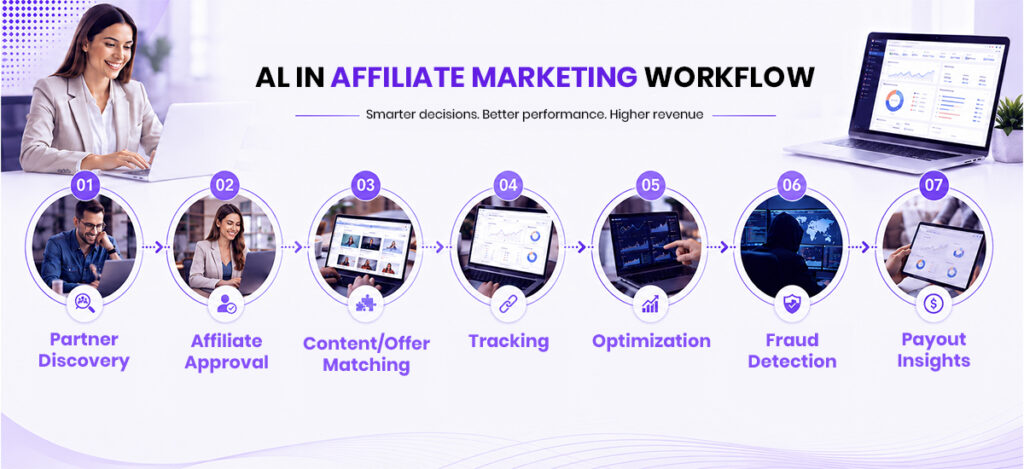
AI now supports the entire affiliate workflow, including:
- Partner discovery: Identifying better-fit affiliates based on niche, audience quality, traffic type, and content style
- Campaign optimization: Adjusting bids, offers, and placements in real time based on performance signals
- Fraud monitoring: Detecting anomalies in traffic patterns, click behavior, and conversion rates before they damage program integrity
- Predictive analytics: Forecasting partner performance and revenue contribution before scaling spend
AI can now support partner discovery with its ability for contextual analysis, large language models, embeddings, and semantic scoring. A major leap from manual to automated recruitment that caused a major shift in content creation, targeting efficiency, and performance forecasting.
What AI Automation Means for Advertisers and Affiliates
For advertisers, running an affiliate program is more reliable with less manual oversight. Affiliates today are expected to know AI-optimized ecosystems. If they can generate clean traffic, create quality content, and ensure consistent conversion signals, they’ll be rewarded with better commission offers. Not to mention stronger partner relationships.
2. Micro-Influencer and Nano-Influencer Partnerships Gain More Value
Authenticity beats reach. And it’s one of the most crucial affiliate marketing trends in 2026 that’s reshaping brand partnership dynamics.
Brands are opting for niche creators, smaller communities, and customer advocates. The vital reason behind this is that brand trust and relevance outweigh follower count. It’s proven that nano and micro-influencers, as old customers, carry higher potential to become strong brand ambassadors. They can create genuine content that converts more quickly.
Why Micro-Influencer Affiliate Campaigns Work
- Higher audience trust due to perceived authenticity
- Better niche alignment between creator and product
- More natural product recommendations — no scripted feel
- Lower upfront cost compared to celebrity creator deals
- Easier performance tracking through unique affiliate links and codes
Best-performing content types for micro-affiliate campaigns include product reviews, how-to tutorials, comparison content, short-form video, newsletter recommendations, and User-Generated Content (UGC).
3. Full-Funnel Tracking Replaces Last-Click Norm
Your customers aren’t sourced from the touch-point any longer. They may discover your product or service through multiple sources, such as a creator video, comparative SEO content, email revisits, or delayed conversions. All before a single commission is awarded.
Last-click attribution misses most of that story. And in 2026, smart affiliate programs are moving past it.
As a case scenario, IMD Business School highlights multi-touch attribution as essential for understanding how customers actually convert and for making fairer payout decisions. Affilae similarly describes holistic tracking as a shift toward valuing every player in the customer journey based on their actual contribution.
Last-Click vs. Multi-Touch vs. Full-Funnel Tracking
| Model | What It Measures | Limitation |
| Last-click | Only the final conversion click | Ignores all prior touchpoints |
| Multi-touch | Multiple clicks across the journey | Still click-dependent |
| Full-funnel | Assisted conversions + incrementality | Most accurate, requires setup |
Better tracking improves affiliate motivation, reduces partner churn, and gives advertisers the data needed to invest in upper-funnel creators, not just bottom-of-funnel coupon sites.
4. First-Party Data Beats Third-Party Tracking
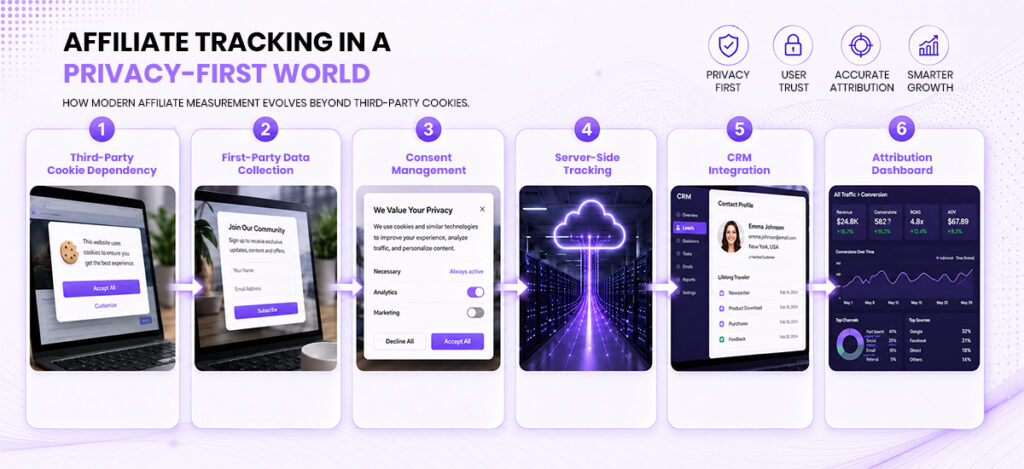
Privacy pressure, browser restrictions, user consent requirements, and evolving regulations have made one thing clear: brands that rely heavily on third-party data are building on an unstable foundation.
It’s worth noting that Google changed course in 2025, maintaining user choice for third-party cookies in Chrome rather than eliminating them with a standalone prompt. But Google’s own developer guidance still recommends auditing cookie usage, testing affiliate tracking when third-party cookies are blocked by user choice, and migrating toward privacy-preserving alternatives.
Building a First-Party Data Strategy for Affiliate Programs
- Collect data through email lists, loyalty programs, purchase history, quizzes, and owned communities
- Use server-side tracking and UTM governance for cleaner affiliate attribution
- Integrate CRM data with affiliate reporting for better segmentation and personalization
- Rely on coupon/code-based tracking as a reliable, consent-friendly fallback
Affiliates can also benefit here by building owned audiences — newsletters, communities, and channels where they control the relationship. Owned audiences reduce platform dependency and increase long-term content value.
5. Mobile-First Affiliate Journeys Are Now Non-Negotiable
Affiliate traffic is increasingly driven through mobile devices — especially through social commerce, short-form video, creator bio links, and mobile search. Hostinger reports that mobile affiliate marketing is expected to drive over 65% of affiliate clicks by 2027. Moreover, 70%+ of affiliate conversions already come from smartphones and tablets.
Mobile Affiliate Campaign Checklist
- ✅ Fast-loading landing pages (under 3 seconds)
- ✅ Clear CTA above the fold
- ✅ Mobile-friendly comparison tables and product displays
- ✅ Simplified checkout flow with minimal friction
- ✅ Trackable links and promo codes for platform-specific campaigns
- ✅ Platform-native creatives (vertical video, story formats, carousels)
Affiliates who optimize their content — and the pages they send traffic to — for mobile will capture a larger share of an already mobile-dominant audience.
6. Social Commerce Turns Creators Into Trackable Sales Channels
Social commerce is the new normal in digital marketing, and it has duly impacted affiliate marketing dynamics. That’s why it’s one of the major affiliate marketing trends in 2026, with a prospect of long-term integrations and widespread use cases.
Practically, TikTok Shop, YouTube, Instagram, etc., are becoming more and more native to affiliate marketing, and affiliates and advertisers should learn to adapt.
Social commerce is increasingly maturing, and creators are becoming interactive points of sale where the gap between inspiration and conversion is shorter than ever. Besides, TikTok, YouTube, and Instagram are key platforms driving social media-led affiliate sales.
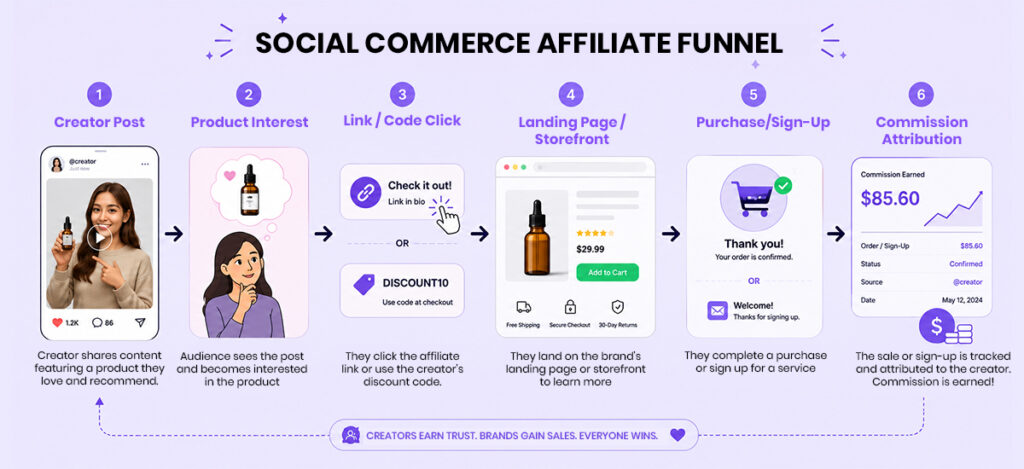
This indicates that advertisers should take social platforms into account to prepare their affiliate assets. They must work on strong product angles, offers, and concise hooks for conversions in a low-attentive environment.
Contact Affiliate Gravity to expand beyond a single channel and develop a broader affiliate partner base across multiple, relevant social channels, content formats, and search engines.
7. Compliance and Quality Control Become Program Priorities
As affiliate marketing trends push programs toward greater scale and automation, the risk of compliance gaps grows with them. Advertisers in regulated industries, such as finance, health, insurance, and e-commerce, face increasing scrutiny over how their affiliate partners represent products and drive traffic.
Tighter regulation, compliance mandates, rising costs, and ROI pressure are all reshaping how advertisers manage performance marketing relationships.
Affiliate Quality Control Framework
- Approve the right partners — Vet for traffic source, audience quality, and content alignment
- Define allowed traffic sources — Paid search, coupon sites, email, content, social
- Monitor fraud signals — Unusual click-to-conversion ratios, bot traffic, geographic anomalies
- Review creatives and claims — Especially for health, financial, or regulated products
- Track performance by partner type — Don’t treat all affiliates the same
- Pay accurately and on time — Payout reliability directly affects affiliate loyalty
Affiliate Statistics also reports that inadequate support from affiliate managers is one of the leading frustrations for affiliate marketers, making quality, responsive support a genuine competitive differentiator for affiliate networks.
8. Commission Models Become More Flexible
Static, one-size-fits-all commission structures are giving way to more nuanced models. IMD notes that commission structures are shifting as brands balance profitability with attracting and retaining high-performing affiliates.
Common models gaining traction in 2026 include:
- CPA (cost per action) — Pay on a specific conversion event
- Revenue share — Percentage of every sale, strong for SaaS and e-commerce
- CPL (cost per lead) — Ideal for service businesses with longer sales cycles
- Tiered commissions — Higher rates unlock as affiliates hit volume benchmarks
- Hybrid models — Combine base CPA with a revenue share component
- Recurring commissions — Especially relevant for subscription products
Advertisers are expected to integrate affiliate networks with flexible offer management to structure deals. This will attract sincere and performance-driven partners, not just volume-focused traffic sources.
Building Smarter Affiliate Partnerships in 2026
The 2026 affiliate marketing trends are focused in one clear direction: the affiliate channel is evolving. You must work on strategy over shortcuts, develop relationships over raw volume, and data-driven decisions over guesswork.
Trust, transparency, and performance— the three old and good fundamental elements of a scalable affiliate program. Whether you’re an advertiser, a partner, or a content creator aiming at effective monetization, the idea remains the same.
Join Affiliate Gravity as we can help advertisers and affiliates connect through a performance-focused ecosystem. Our system focuses on:
- real-time tracking,
- quality control,
- reliable payouts, and
- dedicated support
If you’re ready to build stronger, more scalable affiliate partnerships, connect with Affiliate Gravity today and explore what a performance-first affiliate network can do for your growth.