
If you’re wondering in 2026 how people around you are earning online just by digitally promoting products and services without ownership, the system you’re trying to figure out is affiliate marketing. Now, to explore how affiliate marketing works, read this guide.
Essentially, affiliate marketing is considered by experts to be one of the most scalable marketing techniques to earn online. Its low-risk pattern inspires millions of affiliates and content creators globally to invest time and talent in it. Whether you’re an experienced blogger, content creator, or just starting, understanding its nuances can unlock real earning potential.
To make your tasks easier, Affiliate Gravity brings a clear process roadmap of affiliate marketing. Joining us as an affiliate can give you high-stakes offers, reliable tracking, and consistent payouts. A complete beginner-focused guide to start and scale.
What Is Affiliate Marketing?
At its core, affiliate marketing is a performance-based marketing model that helps affiliates earn commissions or rewards by promoting products or services.
The process involves promoting products or services through blogs, videos, etc., while driving sales or actions via unique referral links. Technically, when visitors click those links, fill out the form, or make purchases, the affiliates earn a commission.
How Affiliate Marketing Works: The Simple Process
Affiliate marketing is far beyond its typical definitions. To truly understand this, let’s take you through its real-world functions and scenarios:
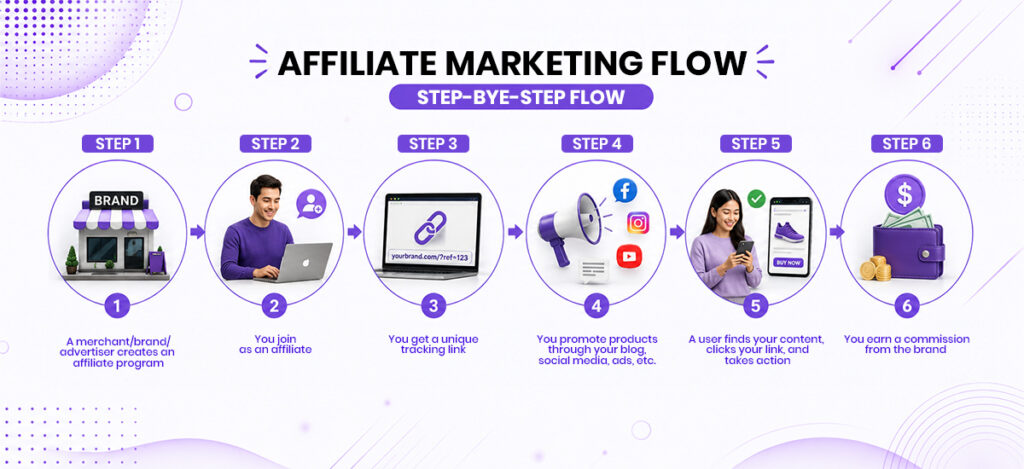
Here’s a beginner-friendly breakdown:
Step-by-Step Flow
- A merchant/brand/advertiser creates an affiliate program
- You join as an affiliate
- You get a unique tracking link
- You promote products through your blog, social media, ads, etc.
- A user finds your content, clicks your link, and takes action
- You earn a commission from the brand
The Core Components of Affiliate Marketing
Understanding these components is critical if you want to move from beginner to profitable affiliate.
1. The Advertiser (Merchant)
The business offers a product or service. Their goal is to increase their sales through external promotion.
2. The Affiliate (Publisher)
The individual or publisher promotes the offer. This could be:
- Bloggers
- YouTubers
- Social media creators
- Paid traffic marketers
3. The Affiliate Network (Platform)
The system that connects advertisers and affiliates while handling:
- Tracking
- Reporting
- Payments
This is where platforms like Affiliate Gravity provide a major advantage by offering:
- Real-time tracking for substantial insights
- Reliable, weekly payouts that build trust and smooth money flow
- Global reach for scaling campaigns
- Dedicated support for campaign optimization
Types of Affiliate Marketing (Quick Breakdown)
Affiliate marketing is diverse. Here are the three main types:
1. Unattached Affiliate Marketing
No personal connection to the product (ads, paid traffic).
2. Related Affiliate Marketing
You promote products in your niche (blog, YouTube).
3. Involved in Affiliate Marketing (Sometimes As An Influencer)
You personally use and recommend products to your followers (high trust, high conversion).
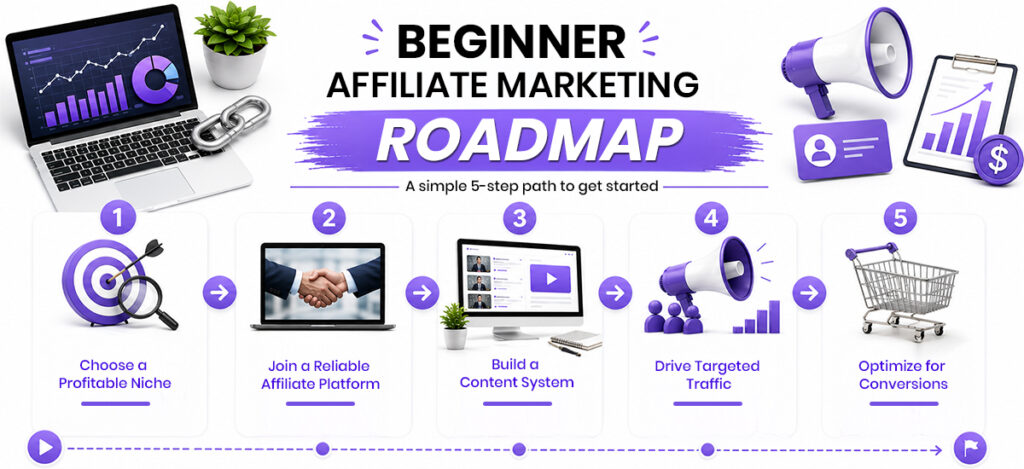
How Beginners Can Start Affiliate Marketing (Practical Roadmap)
Starting affiliate marketing isn’t complicated. However, doing it right from the beginning matters.
Step 1: Choose a Profitable Niche
A niche defines your audience and content direction. Good niches:
- Solve real problems
- Have a strong demand
- Allow consistent content creation
Examples:
- Fitness
- Personal finance
- Tech tools
- Beauty and skincare
Step 2: Join a Reliable Affiliate Platform
Instead of managing multiple programs manually, beginners benefit from using a centralized network like Affiliate Gravity, where you can:
- Access multiple offers
- Track performance in one dashboard
- Receive consistent payouts
This reduces friction and helps you focus on growth.
Step 3: Build a Content System
Affiliate marketing is driven by content. Your goal is to attract and convert traffic.
Popular content formats:
- Blog posts (SEO-driven)
- Product reviews
- Comparison articles
- Tutorials and guides
- Short-form videos (TikTok, Reels)
Step 4: Drive Targeted Traffic
Traffic is the foundation of affiliate marketing success.
Main channels:
- Search Engine Optimization (SEO)
- Social media marketing
- Email marketing
- Paid ads (advanced strategy)
Step 5: Optimize for Conversions
Once you get traffic, focus on:
- Improving click-through rates
- Writing better calls-to-action
- Testing different offers
- Analyzing data
How Do Affiliates Earn Money?
Understanding how you get paid is essential.
Common Models:
1. Cost Per Sale (CPS)
You earn when a purchase is made.
2. Cost Per Action (CPA)
You earn when users complete actions like signups.
3. Cost Per Click (CPC)
You earn based on the traffic generated.
Reliable affiliate platforms ensure:
- Accurate tracking of actions
- Transparent reporting
- On-time payments
This is critical for long-term growth and trust
Why Affiliate Marketing Is Beginner-Friendly
Most beginners can start affiliate marketing with minimal to zero risk. The popularity of affiliate marketing among beginners continues to grow, since it offers:
- Low startup cost
- No inventory required
- Workplace flexibility (work from anywhere)
- Scalable income prospect
However, going easy on affiliate marketing may work against a beginner’s expectations. The success depends on:
- Choosing the right niche
- Consistent content
- Promoting the brand properly
- Connecting the product/service with the followers
- Data-driven optimization
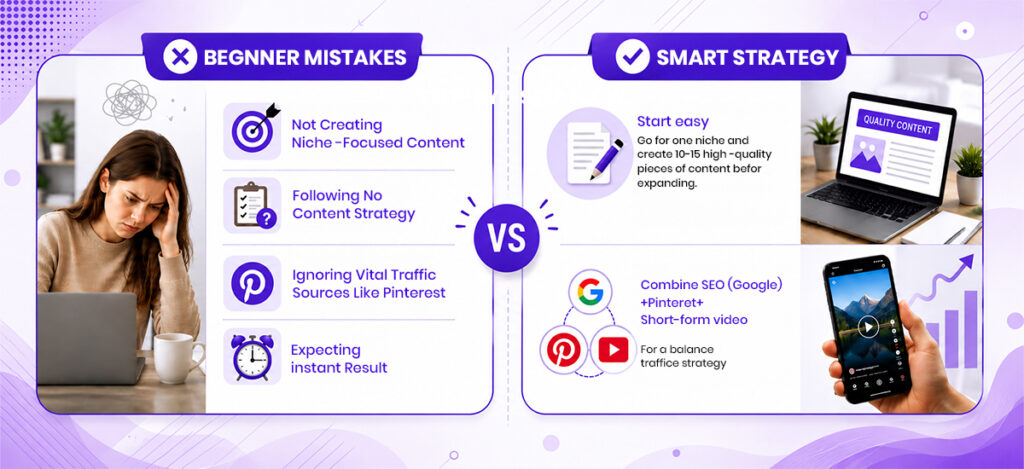
4 Common Affiliate Mistakes Beginners Make
As a beginner, you may fail in affiliate marketing due to a lack of structure, strategic execution, and patience. It’s not about the marketing model, but your approach.
Nonetheless, avoiding these five common affiliate mistakes will not only save your affiliate resolution but also accelerate your progress, increasing the chances of consistent income.
1. Not Creating Niche-Focused Content
A definite niche can guide you on how to promote the product or service to the right audience. Otherwise, your conversion will suffer.
Let’s say your niche is tech gadgets, fitness, or personal finance. You start by building topical authority. This guides the search engine to extract relevant information from your content, boosting SEO ranking and validating your product recommendations to users.
Pro Tip: Start easy. Go for one niche and create 10–15 high-quality pieces of content before expanding.
2. Following No Content Strategy
Publishing random blog posts or videos without a plan leads to inconsistent traffic and weak conversions. Affiliate marketing works best when content is aligned with user intent and the buyer journey.
Unplanned blog posts or videos can compromise your traffic consistency and conversions. The best bet in affiliate marketing is to align user intent and buyer journey with the content.
A powerful content strategy means:
- Informational content (guides, “how-to” articles)
- Comparison content (“Product A vs Product B”)
- Transactional content (reviews, best-of lists)
This structured approach not only improves SEO performance but also increases your chances of converting visitors into buyers.
3. Ignoring Vital Traffic Sources Like Pinterest
Overlooking vital traffic sources can make your affiliate marketing stagnant. Most beginners, by default, expect results from Google or Instagram, while Pinterest can generate consistent, long-term traffic.
Pinterest is a visual content site that also works like a visual search engine, unlike social platforms. Highly optimized Pins can keep generating traffic for months or even years.
Diversifying your traffic sources is critical because:
- It reduces dependency on a single platform
- It increases reach across different audience types
- It creates multiple entry points into your content funnel
Pro Tip: Combine SEO (Google) + Pinterest + short-form video for a balanced traffic strategy.
4. Expecting Instant Results
In affiliate marketing, patience pays off, not hastiness or random actions. One of the biggest reasons that many beginners fail in affiliate marketing is that they quit too easily after not getting instant results.
Reality check:
- SEO traffic can take 3–6 months to build
- Content needs time to rank and gain authority
- Conversion optimization requires testing
Remember, affiliate marketing is a sustainable, long-term asset-building marketing technique. Only those who are consistent, analytical, and persistent in improving techniques can thrive.
Avoiding these mistakes becomes much easier when you have the right platform supporting your efforts.
To get things done more easily, join Affiliate Gravity. Beginners can:
- Access quality, conversion-ready offers
- Track performance in real time
- Receive reliable weekly payouts without delays
- Get support for optimizing campaigns
With us, you stop guessing and start growing with a structured system and measurable dataset.
Advanced Insight: What Actually Makes Affiliate Marketing Work
When most basic guides stop, we further work on making things actually work. These are the things that make Affiliate Gravity stand out:
1. Traffic Quality > Traffic Quantity
Our approach: 100 targeted users that outperform 1,000 random visitors.
2. Offer Selection
Not all affiliate offers convert equally. With Affiliate Gravity, you can choose:
- Trending, proven products
- Niches that are relevant to your audience
- Advertisers or merchants with high commission potential
3. Data Tracking
Our robust real-time tracking helps you:
- Identify what works
- Eliminate what doesn’t
- Scale winning campaigns
Platforms like Affiliate Gravity simplify this with real-time analytics and optimization insights.
How Affiliate Gravity Helps Beginners Succeed
Affiliate Gravity offers an integrated affiliate setup, unlike many fragmented ones, which is viable for both beginners and experienced affiliates.
Affiliate Gravity provides that structure by offering:
- Reliable weekly and monthly payouts that build long-term trust
- Real-time tracking for faster optimization
- Quality-controlled offers to improve conversions
- Dedicated support for scaling strategies
- Global reach for wider earning potential
Understanding how affiliate marketing works is the first step toward building a scalable online income stream.
But execution matters more than theory.
If you’re serious about starting, using a structured platform like Affiliate Gravity can save time, reduce confusion, and help you focus on growth instead of technical barriers.
Start simple. Stay consistent. Optimize as you go.
That’s how beginners turn affiliate marketing into a real income stream.
FAQ:
What is affiliate marketing for beginners?
For beginners, affiliate marketing involves promoting products using referral links and earning commissions based on actions taken by visitors.
Do I need a website to start affiliate marketing?
No. You can start with social media, YouTube, or even email marketing.
How much can beginners earn from affiliate marketing?
Beginners can earn up to thousands of dollars per month, depending on niche, traffic, and consistency.
Is affiliate marketing legit?
Yes, it’s a widely used performance marketing model adopted by major brands.
Is affiliate marketing passive income?
It can become passive over time, but it requires active effort in the beginning.
How does Affiliate Gravity help affiliates?
Affiliate Gravity provides:
1. Reliable payouts
2. Real-time tracking
3. Global offers
4. Dedicated support
Making it easier for affiliates to scale efficiently.
What skills are needed for affiliate marketing?
Basic skills include:
1. Content creation
2. SEO
3. Social media marketing
4. Data analysis