
In 2026, if you are struggling to scale business with Affiliate marketing, then this article is for you.
Most businesses waste money chasing attention. They spend heavily on ads. They burn budgets on campaigns that stop working the moment spending stops. Then they wonder why customer acquisition keeps getting more expensive. Here’s the truth most agencies will not tell you.
Affiliate marketing is no longer just a “side channel.”
Today, it is one of the most scalable growth systems in digital business.
But there is a problem. The industry is flooded with fake affiliates, low-quality traffic, shady attribution tricks, and partners chasing quick commissions instead of real business growth. That is why brands need a smarter strategy now.
This guide will show exactly how businesses can scale using affiliate marketing the right way. Not the outdated way.The profitable way.
The Marketing Channel Most Brands Still Underestimate
The smartest brands are not using affiliates as random coupon publishers anymore. They are building complete partner ecosystems powered by creators, niche publishers, influencers, communities, review websites, comparison platforms, email marketers, and even loyal customers.
And the numbers prove it.
The global affiliate marketing industry is now worth over $20 billion and continues to grow rapidly. Industry forecasts indicate affiliate marketing spending will exceed $15 billion in the US alone by 2028.
This is not hype.
This is a shift in how modern customer acquisition works.
If done right, affiliate marketing becomes:
- A low-risk growth engine
- A scalable revenue channel
- A trust-driven acquisition system
- A long-term brand amplifier
Why Affiliate Marketing Scales Better Than Traditional Ads
You Only Pay for Results
That is the biggest advantage.
Traditional advertising burns money upfront.
Affiliate marketing works differently.
You pay only when a measurable action happens.
That could be:
- A sale
- A lead
- A subscription
- An app install
- A booked demo
This performance-based model protects cash flow and lowers risk. For growing brands, this matters a lot. Especially when paid advertising costs keep rising across Meta, Google, TikTok, and YouTube.
Affiliate Marketing Builds Trust Faster
Consumers trust people more than brands.That is why creator-led commerce is exploding right now. Micro influencers and niche creators often outperform celebrities because their audiences trust them more deeply.
Recent industry data showed that micro creators are increasing rapidly in value as brands now prioritize authenticity and conversion quality over follower counts. A trusted recommendation converts better than a flashy ad.
Always.
It Expands Reach Without Expanding Payroll
One affiliate manager can activate hundreds of revenue-driving partners. That gives brands massive distribution without building huge internal marketing teams. Think about it.
Instead of hiring:
- More sales reps
- More ad buyers
- More content teams
You create a partner network that grows alongside your business. That is scalable leverage.
The Biggest Affiliate Marketing Mistakes Businesses Make
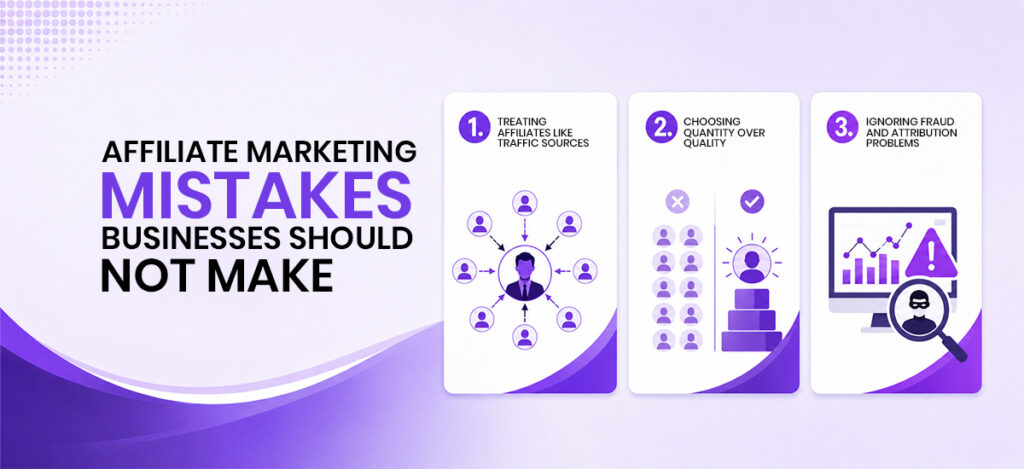
Treating Affiliates Like Traffic Sources
This is the old-school mistake. Modern affiliates are not just publishers.
They are:
- Media buyers
- Content creators
- SEO experts
- Community builders
- Industry educators
- Trust brokers
If brands treat them like disposable traffic, good affiliates leave.
The best programs build relationships.
Not transactions.
Choosing Quantity Over Quality
Thousands of low-quality affiliates mean nothing. Ten strong affiliates can outperform 5,000 inactive partners.
The goal is not “more affiliates.”
The goal is:
- Better audience alignment
- Higher conversion quality
- Stronger brand fit
- Long-term customer value
That changes everything.
Ignoring Fraud and Attribution Problems
Fake leads. Cookie stuffing. Trademark bidding. Bot traffic. Duplicate conversions. The affiliate industry has real problems.
Brands that scale successfully invest in:
- Fraud detection tools
- Proper attribution models
- Transparent tracking
- Partner vetting systems
Without this, affiliate marketing becomes chaos.
How Businesses Can Build a Scalable Affiliate Program
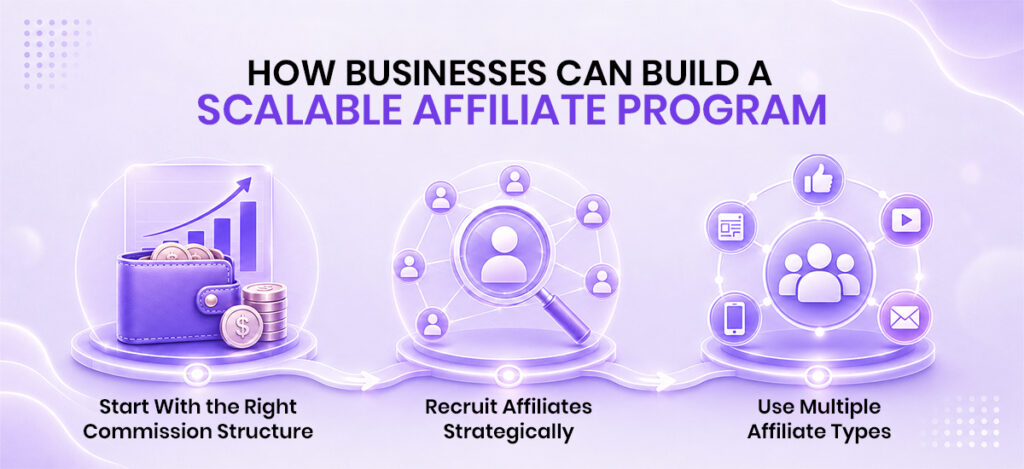
Start With the Right Commission Structure
Your payout model controls affiliate behavior. If commissions are too low, top affiliates ignore you. If commissions are too high, margins collapse.
The sweet spot depends on:
- Industry margins
- Customer lifetime value
- Average order value
- Repeat purchase rate
Subscription businesses often pay more upfront because retention creates long-term profit. E-commerce brands usually optimize for repeat customers. Smart commission structures drive sustainable growth.
Recruit Affiliates Strategically
Not every affiliate is valuable. The best brands recruit intentionally.
Focus on partners with:
- Relevant audiences
- Genuine engagement
- Strong SEO visibility
- High-quality content
- Proven conversion history
This is where many businesses fail. They open public signups and hope for results. That attracts junk traffic. Real growth comes from curated partnerships.
Use Multiple Affiliate Types
Diversification protects growth.A scalable affiliate ecosystem usually includes:
Content Publishers
Blogs, review sites, niche media websites.
Influencers & Creators
TikTok, Instagram, YouTube, and LinkedIn creators.
Email Affiliates
Newsletter operators with loyal audiences.
Loyalty & Cashback Platforms
Useful for scaling conversions.
Comparison & Review Sites
Powerful for high-intent buyers.
Communities & Forums
Often overlooked but extremely valuable.
The best affiliate programs never rely on one traffic source.
Why Creator Partnerships Are Dominating Affiliate Marketing
The Creator Economy Changed Everything
Affiliate marketing and creator marketing are merging. The creator economy ad market reached nearly $37 billion recently and continues growing rapidly.
Creators now drive:
- Product discovery
- Trust building
- Buying decisions
- Social proof
- Conversion intent
This is why platforms like LTK and ShopMy exploded in popularity. Modern affiliate growth is no longer just coupon codes. It is relationship-driven commerce.
Video-First Affiliate Marketing Is Winning
Video content dominates online behavior.
Consumers want:
- Demonstrations
- Reviews
- Tutorials
- Comparisons
- Real experiences
Industry reports show video now represents over 62% of internet traffic in many markets. That is reshaping affiliate strategy completely. Brands that ignore video affiliates are falling behind.
The Technology Stack Every Serious Affiliate Program Needs
Affiliate Tracking Software
Without accurate tracking, scaling becomes impossible.
Popular affiliate platforms include:
- Impact
- PartnerStack
- Trackier
- ShareASale
- CJ Affiliate
- Refersion
Good tracking software helps with:
- Attribution
- Fraud prevention
- Commission automation
- Performance analysis
- Partner management
Analytics and Attribution Tools
Affiliate marketing should never operate blindly.
Brands need to track:
- Customer acquisition cost
- Conversion rates
- Assisted conversions
- Lifetime value
- Incremental revenue
- Channel overlap
Data separates scalable programs from failing ones.
How Smart Businesses Keep Affiliates Motivated
Affiliates Want More Than Commissions
Top affiliates value partnerships.
The best brands provide:
- Exclusive offers
- Faster payouts
- Dedicated support
- Co-branded campaigns
- Early product access
- Better creatives
Great affiliates have options. If a program feels messy, they leave quickly.
Communication Changes Performance
Most affiliate programs fail at communication.
The best affiliate managers consistently share:
- New promotions
- Winning campaigns
- Seasonal opportunities
- Conversion insights
- Creative updates
Affiliates perform better when they feel involved.
Simple.
The Real Secret Behind Long-Term Affiliate Growth
Focus on Customer Quality, Not Just Sales
Many businesses chase raw volume. That is dangerous. Cheap customers are expensive later.
Smart brands measure:
- Retention rate
- Refund rate
- Average order value
- Repeat purchases
- Customer lifetime value
A high-converting affiliate is useless if customers never stay. Long-term profitability matters more than vanity numbers.
The Future of Affiliate Marketing Is Smarter Partnerships
AI and Automation Are Changing the Industry
AI is now improving:
- Partner discovery
- Fraud detection
- Attribution modeling
- Campaign optimization
- Personalized offers
Reports show that around 75% of buyers are already integrating AI into creator and affiliate workflows. But automation alone will not win. Human trust still drives conversions.
Brands Will Need Better Partner Standards
The affiliate space is becoming crowded. That means businesses must become more selective. The future belongs to brands that prioritize:
- Transparency
- Trust
- Compliance
- Long-term partnerships
- High-quality creators
- Ethical marketing
The era of spammy affiliate tactics is dying.
The Brands Winning With Affiliate Marketing Think Long-Term
Affiliate marketing is not a shortcut. It is infrastructure. When built correctly, it becomes one of the most predictable and scalable growth channels in business. But scaling requires discipline. Brands must stop chasing random affiliates and start building strategic partnerships.
Because the market has changed. Consumers trust creators more than ads. Performance marketing is replacing wasteful spending. And businesses that master affiliate ecosystems now will dominate customer acquisition over the next decade. The opportunity is massive. But only for brands willing to do it properly.
Questions Smart Brands Are Asking Before Scaling Affiliate Marketing
1. How long does affiliate marketing take to scale?
Usually, 3–6 months for consistent traction. Strong recruitment and relationship building speed things up fast.
2. Is affiliate marketing only for e-commerce brands?
Not at all. SaaS, finance, education, travel, wellness, and B2B brands scale successfully with affiliate partnerships.
3. What is the biggest affiliate marketing mistake businesses make?
Focusing on affiliate quantity instead of partner quality. A few strong affiliates outperform thousands of weak ones.
4. How do brands stop affiliate fraud?
Use tracking software, fraud detection tools, manual vetting, and transparent attribution systems.
5. Are influencers considered affiliates now?
Yes. Creator-led affiliate marketing is now one of the fastest-growing segments in performance marketing.
6. Can small businesses scale with affiliate marketing?
Absolutely. Affiliate marketing is often cheaper and safer than paid ads for growing brands.
7. What KPIs matter most in affiliate marketing?
CAC, conversion rate, ROAS, customer lifetime value, retention rate, and incremental revenue.
8. Which industries grow fastest with affiliate marketing?
E-commerce, SaaS, fintech, beauty, health, education, and creator-led brands are growing rapidly.