Affiliate marketing has evolved dramatically over the last decade, but one question still confuses both beginners and experienced marketers alike: CPA vs. CPL vs. CPC — which model is best?
After spending 10 years in the affiliate industry, analyzing trends, scaling campaigns, and watching thousands of affiliates succeed or fail, one thing has become clear: there’s no universal winner.
The right model depends on your goals, budget, niche, and patience level. Some marketers thrive with CPC because of fast traffic generation, while others build sustainable profits through CPA or CPL campaigns.
Understanding how each model works — and when to use it — can save advertisers thousands of dollars and months of frustration.
Benefits for Advertisers (CPA vs. CPL vs. CPC)
Before choosing between the bidding strategies (CPA vs. CPL vs. CPC), advertisers must understand that each model serves a different purpose in the marketing funnel. Some businesses prioritize visibility and traffic. Others care about collecting leads. Many focus only on conversions and revenue. That’s exactly why these three models exist.
Here’s the core difference:
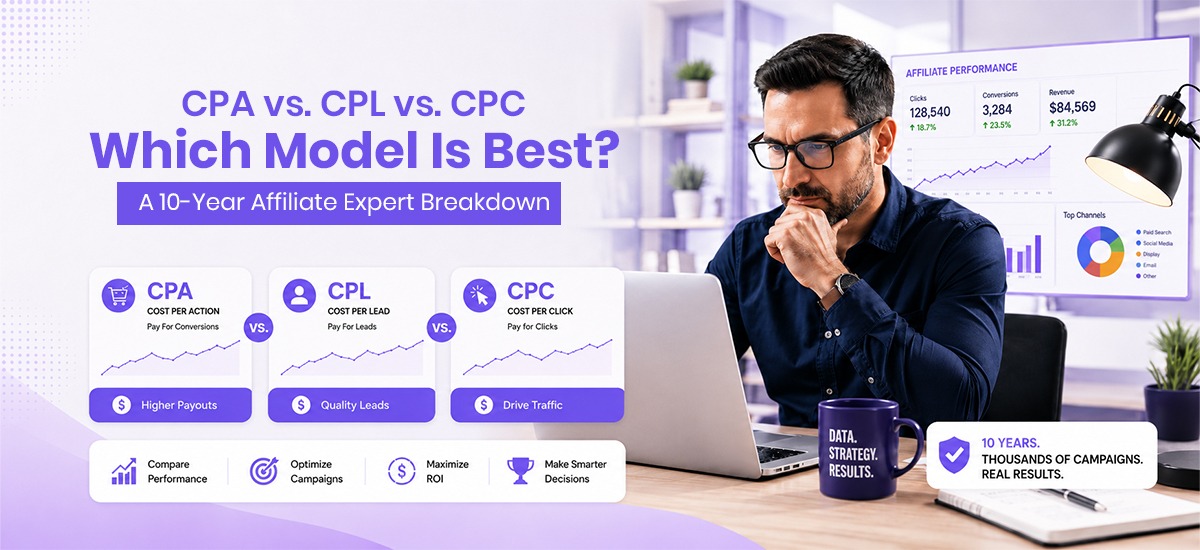
| Model | Full Form | Advertiser Pays For |
| CPC | Cost Per Click | Website clicks |
| CPL | Cost Per Lead | Lead submissions |
| CPA | Cost Per Action | Specific conversions or sales |
From an advertiser’s perspective, choosing the right model can:
- Improve ROI
- Reduce wasted ad spend
- Increase campaign scalability
- Align marketing with business goals
- Optimize conversion quality
The challenge is that many affiliates jump into a model simply because it’s trending. That’s usually a mistake. Smart advertisers choose based on data, not hype.
1. CPC: Introduction, Advantages, Disadvantages, and Who Should Choose It
In CPA vs. CPL vs. CPC bidding, what is CPC?
CPC (Cost Per Click) is one of the oldest and simplest advertising models. Advertisers pay publishers or platforms every time someone clicks on their ad. Popular platforms like Google Ads and Meta Ads Manager heavily rely on CPC campaigns. In this model, the advertiser pays for traffic — not leads or sales.
Advantages of CPC
1. Immediate Traffic Generation
CPC campaigns can send visitors to your website almost instantly. This is useful for new businesses trying to build awareness quickly.
2. Easy to Launch
Compared to CPA campaigns, CPC advertising requires less backend optimization.
3. Brand Visibility
Even if users don’t convert immediately, your brand still gains exposure.
4. Flexible Budgeting
Advertisers can start with small daily budgets and scale gradually.
Disadvantages of CPC
1. Risk of Low-Quality Traffic
Not every click converts. In fact, many clicks may come from users with no buying intent.
2. Click Fraud
One major issue in CPC advertising is fake or bot clicks that waste ad spend.
3. Weak ROI Tracking
Traffic alone doesn’t guarantee profitability.
4. Rising Competition
Highly competitive niches like finance, insurance, and SaaS often have extremely expensive CPC rates.
Who Should Choose CPC and Why?
CPC works best for:
- Brand awareness campaigns
- New product launches
- Businesses wanting fast website traffic
- Advertisers with strong landing pages and conversion funnels
If your business needs visibility first and conversions later, CPC can be a strong starting point.
However, CPC requires continuous optimization. Without proper targeting, advertisers often burn budgets quickly.
2. CPL: Introduction, Advantages, Disadvantages, and Who Should Choose It
In CPA vs. CPL vs. CPC bidding, what is CPL?
CPL (Cost Per Lead) is a model where advertisers pay only when users submit their information, such as:
- Email addresses
- Phone numbers
- Contact forms
- Trial signups
- Appointment bookings
This model is extremely popular in industries where nurturing leads is part of the sales process.
Advantages of CPL
1. Higher Intent Traffic
Unlike CPC visitors, CPL users take an actual step by sharing their information.
2. Better Customer Acquisition
Leads can be retargeted later through email or sales calls.
3. Predictable Lead Generation
Businesses can forecast lead volume more accurately.
4. Stronger Data Collection
CPL campaigns help businesses build valuable customer databases.
Disadvantages of CPL
1. Lead Quality Issues
Not every lead becomes a paying customer.
2. Fake Submissions
Some affiliates generate low-quality or incentivized leads.
3. Longer Conversion Cycles
Leads often require follow-ups before turning into revenue.
4. CRM Dependency
Without proper lead management systems, CPL campaigns lose effectiveness.
Who Should Choose CPL and Why?
CPL is ideal for:
- Insurance companies
- Real estate businesses
- Education platforms
- SaaS companies
- B2B services
If your sales process involves consultation, follow-up emails, or demos, CPL is often more profitable than CPC.
From my experience, businesses with skilled sales teams perform exceptionally well with CPL campaigns because they can convert leads into long-term customers.
3. CPA: Introduction, Advantages, Disadvantages, and Who Should Choose It
In CPA vs. CPL vs. CPC bidding, what is CPA?
CPA (Cost Per Action) is the most performance-driven model in trending affiliate marketing.
Advertisers only pay when a specific action occurs, such as:
- Product purchases
- App installs
- Subscription signups
- Paid memberships
- Deposits
In simple terms, CPA minimizes advertiser risk because payment happens only after measurable results.
Advantages of CPA
1. Maximum ROI Control
Advertisers pay only for completed actions.
2. Lower Financial Risk
Unlike CPC, wasted clicks don’t directly cost money unless they convert.
3. Easier Profit Forecasting
CPA campaigns are easier to scale once conversion metrics are stable.
4. Affiliate Motivation
Affiliates focus heavily on conversion optimization because their earnings depend on performance.
Disadvantages of CPA
1. Harder to Optimize Initially
CPA campaigns require advanced funnel tracking and testing.
2. Strict Compliance Rules
Advertisers often impose strict traffic quality requirements.
3. Higher Competition
Top-performing CPA niches attract experienced affiliates.
4. Longer Learning Curve
Beginners frequently struggle because CPA success depends on data analysis and conversion optimization.
Who Should Choose CPA and Why?
CPA works best for:
- E-commerce brands
- Subscription businesses
- Mobile app companies
- Gambling and gaming offers
- Finance and fintech companies
If your primary goal is measurable profitability, CPA is often the strongest model.
After spending 10 years in affiliate marketing, I’ve seen CPA consistently outperform other models for businesses that already understand their customer acquisition costs.
Key Performance Indicators(CPC vs CPL vs CPA)
Choosing the right model becomes easier when you understand the KPIs behind each one.
| Model | Key Metrics |
| CPC | CTR, Bounce Rate, CPC Cost, Session Duration |
| CPL | Lead Quality, Cost Per Lead, Conversion Rate |
| CPA | ROAS, Cost Per Acquisition, Lifetime Value |
Consideration of Facts for Choosing the Right Conversion Model
Selecting between CPA vs. CPL vs. CPC requires strategic thinking.
The “best” model depends entirely on business structure, goals, and operational capacity.
Budget: Metrics, Forecast, and Payback Period
Low-Budget Advertisers
Businesses with smaller budgets often begin with CPC because it provides immediate data and traffic insights.
However, low-budget CPC campaigns can become expensive if targeting is weak.
Medium-Budget Advertisers
CPA campaigns require substantial testing of budgets initially.
The payback period is slower, but customer value tends to increase.
High-Budget Advertisers
CPA campaigns require substantial testing budgets initially.
But once optimized, CPA becomes highly scalable and predictable.
This is why large affiliate networks heavily prioritize CPA partnerships.
Niche the Advertisers Want to Focus On
Different industries naturally perform better with different models.
| Niche | Best Model |
| News & Media | CPC |
| SaaS | CPL / CPA |
| E-commerce | CPA |
| Real Estate | CPL |
| Finance | CPA |
| Education | CPL |
| Blogging | CPC |
For example:
- E-commerce brands usually prioritize sales, making CPA more effective.
- Educational institutions benefit from lead nurturing, making CPL ideal.
- Publishers and content sites monetize traffic effectively with CPC.
Your niche heavily influences profitability potential.
The Amount of Time Advertisers Are Willing to Spend
This factor is often ignored, but it’s critical.
CPC Requires Constant Monitoring
Traffic campaigns need ongoing optimization, targeting adjustments, and click-quality analysis.
CPL Requires Follow-Up Systems
Lead generation campaigns demand email sequences, CRM management, and sales nurturing.
CPA Requires Deep Testing
CPA campaigns often involve landing page testing, funnel optimization, and audience segmentation.
In my experience, advertisers who underestimate the time commitment usually fail regardless of the model they choose.
Which One Is the Best Model?
Here’s the truth most affiliate “gurus” won’t tell you:
There is no single best model among CPA vs. CPL vs. CPC.
The best model depends on your:
- Business goals
- Budget
- Experience level
- Sales process
- Risk tolerance
- Traffic quality
However, from a long-term profitability perspective, CPA is usually the strongest model for mature advertisers.
Why?
Because CPA focuses directly on measurable outcomes.
You pay for actual results, not curiosity clicks or unqualified leads.
That said,
- CPC is excellent for brand awareness and rapid traffic.
- CPL is ideal for relationship-based industries.
- CPA dominates performance marketing and scalability.
The smartest advertisers often combine all three models strategically instead of relying on only one.
Final Thoughts
The debate around CPA vs. CPL vs. CPC will continue as digital advertising evolves, but the fundamentals remain the same: every model serves a specific purpose.
After a decade in affiliate marketing, one lesson stands out above everything else, success doesn’t come from chasing trends.
It comes from understanding how each model aligns with your business goals.
Choose CPC if visibility and traffic matter most.
Choose CPL if your business thrives on lead nurturing and long-term customer relationships.
Choose CPA if you want scalable, performance-driven profitability.
The best advertisers are not loyal to one model. They adapt based on data, audience behavior, and market conditions.
And in affiliate marketing, adaptability always wins.
According to recent industry insights from Affiliate Gravity, affiliate marketing in 2026 is becoming heavily driven by AI automation, micro-influencer partnerships, first-party data, and mobile-first strategies.