

After 15 years in this business, I’ve watched thousands of marketers make the same mistake. They pick a Profitable Affiliate Marketing niche because it’s “hot,” not because it’s smart.
Here’s the truth nobody tells beginners: affiliate marketing isn’t saturated. Bad niche selection is what’s saturated.
The industry itself is booming. It’s valued at roughly $17 billion and is on track to reach $27.78 billion by 2027, growing at about 10% per year. There’s room for you in there. You just need to stop picking niches with your gut and start picking them with data.
Grab a coffee. This is the A-to-Z I wish someone had handed me in year one.
Why Your Niche Decision Makes or Breaks Everything Else
Your niche isn’t just a “topic.” It decides your competition, your commission ceiling, and how long you’ll survive before quitting.
Pick wrong, and you’ll burn months writing content nobody searches for. Pick right, and every article you write compounds.
Here’s a number that should motivate you. The average affiliate marketer earns around $8,038 a month, but experienced marketers out-earn beginners by 9.45 times. That gap isn’t luck. It’s a niche strategy, applied consistently.
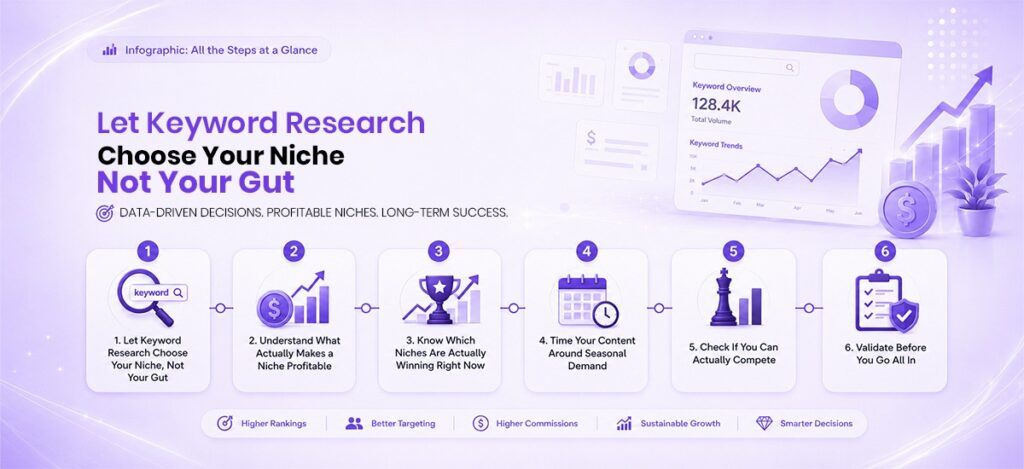
Step 1: Let Keyword Research Choose Your Niche, Not Your Gut
Before you fall in love with an idea, check if people are actually searching to buy in that space. This is non-negotiable.
Use free or paid tools like Google Keyword Planner, Ahrefs, SEMrush, or Ubersuggest. You’re hunting for three types of intent: informational, navigational, and transactional.
Transactional keywords are gold. Think “best [product],” “[product] vs [competitor],” or “[product] alternatives”.
These phrases mean someone’s wallet is already open. Chase them harder than you chase traffic volume.
Step 2: Understand What Actually Makes a Niche Profitable
Big search volume alone means nothing. I’ve seen marketers rank #1 for a keyword and still earn pennies.
Profitability comes from four things stacking together: real market size, manageable competition, buyer intent, and high-value products. A niche with 1,000 searches from people ready to spend $500 beats 10,000 searches from bargain hunters every single time.
Also, chase recurring commissions wherever you can. Getting paid every month a customer stays subscribed is how six-figure affiliate businesses are actually built, not one-off sales.
Step 3: Know Which Niches Are Actually Winning Right Now
Let’s talk numbers, because vague advice like “follow your passion” doesn’t pay bills.
Finance and FinTech
This niche pays some of the highest commissions in the game, often $50–200 per lead. The global financial services market is projected to grow from $20.4 trillion in 2020 to over $28.5 trillion by 2025.
SaaS and AI Tools
Software affiliate programs commonly offer 20–50% recurring monthly commissions. The global software market alone was projected to jump from $930.93 billion in 2020 to $1,493.07 billion by 2025.
Health and Wellness
People will always pay to feel and look better. Online health and beauty sales keep growing at double-digit rates, and repeat purchases are the norm here.
Home Improvement and Decor
This market was projected to grow 20% to reach $202 billion by 2024, fueled by more people working from home.
Travel
Despite past disruptions, travel keeps bouncing back. Programs like Booking.com offer commissions reaching up to 34%.
Gaming and eSports
The industry is expected to reach nearly $546 billion by 2028 and now spans consoles, VR, and mobile.
Pet Care
Pet owners spend like their pets are family. This niche has stayed emotionally sticky and consistently profitable.
One more stat to sit with: 63% of people aged 18–34 trust influencers more than traditional brand ads when shopping online. That’s your audience, waiting for a trustworthy voice. Be that voice.
Step 4: Time Your Content Around Seasonal Demand
This is the strategy most beginners completely skip. Different niches spike at predictable times of the year.
Fitness explodes in January. Travel peaks before summer and winter holidays. Tax content surges January through April, and gift-related searches explode in November and December.
Publish your content 4–6 weeks ahead of these spikes. Marketers who time this right can see earnings jump 200–300% during peak season compared to off-season months.
Step 5: Check If You Can Actually Compete
A hot niche with impossible competition is a dead end. Look at who’s ranking on page one for your target keywords.
If it’s all billion-dollar brands, walk away or find a narrower angle. Aim for keywords with a difficulty score under 30–40 if you’re still building authority.
Also, confirm the niche has enough monetization options. A healthy niche typically has 30 or more affiliate programs to choose from.
Step 6: Validate Before You Go All In
Don’t spend six months on a niche you haven’t stress-tested. Try this simple exercise first.
Can you brainstorm 50 unique content ideas for it right now? If you’re stuck at 15, the niche is too thin.
Spend time on Reddit and niche forums too. Real questions from real people reveal real buying pain points, and that’s content gold.
The Reality Check: Passion Still Matters
Data should drive your decision, but don’t ignore your interest completely. You’ll be writing about this niche for years.
Pick something you can stay curious about, even on your tired days. That’s how consistency survives past month three.
Final Word: Start Before You’re “Ready”
Here’s my honest take after 15 years. Perfect niches don’t exist, but profitable, well-validated ones absolutely do.
The market isn’t too crowded for you. It’s too crowded for people who never do the research in the first place.
Use the keyword data, check the competition, time your seasons, and validate before committing. Then show up and publish, consistently, even when it’s boring.
That’s the real “secret.” There isn’t one beyond doing the unglamorous homework first. Also you may read
Affiliate Marketing Secrets Smart Brands Don’t Want to Reveal.
Your Burning Questions, Answered Fast
What’s the single most important factor when choosing a niche?
Buyer intent, actually. A smaller audience ready to spend beats a huge audience that’s just browsing.
How long until an affiliate niche actually makes money?
Most marketers see meaningful traffic in 4–6 months with consistent publishing. Real income usually builds by month 9–12.
Should I pick a broad niche or a narrow sub-niche?
Go narrow at the start. A tight sub-niche like “ergonomic chairs for remote workers” ranks faster than a broad “home office.”
How many affiliate programs should exist in a good niche?
Aim for at least 30 available programs. That gives you options if one program lowers commissions or shuts down.
What commission rate should I expect?
It varies widely, from 5% on physical products to 50% recurring on SaaS tools. Recurring commissions are usually the most sustainable long-term.
Are low-competition niches always better?
Not always. Sometimes low competition means low demand too, so check search volume before celebrating.
How do I know if a niche is seasonal or evergreen?
Check Google Trends for 12 months of search history. Flat lines mean evergreen, sharp spikes mean seasonal.